|
St
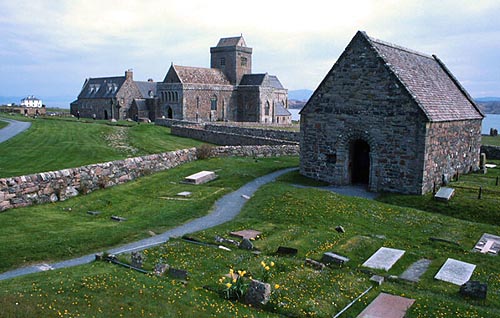
Orans Abbey built in the11th century has been rebuilt over time and was
completely restored in the 20th century. The oldest part is that of the
restored is St Oran's Chapel, to the south of the abbey on the right,
which is plain and unadorned save for its splendid 11th-century Norman
doorway. It is said that Columba was prevented from completing the
building of the original chapel until a living person had been buried in
the foundations. His friend Oran volunteered and was duly buried. Columba
later asked for the face to be uncovered so that he could bid a final
farewell to his friend, but Oran was found to be alive and claimed he had
seen Heaven and Hell, describing them in such blasphemous terms that
Columba ordered he be covered up immediately!
Surrounding the chapel is the Reilig Odhrain, the sacred burial ground,
which is said to contain the graves of 48 Scottish kings, including
Macbeth's victim, Duncan, as well as four Irish and eight Norwegian kings.
The stones you see today are not the graves of kings but of various
important people from around the West Highlands and Islands. The most
recent is that of John Smith, leader of the British Labour Party from 1992
until his untimely death in 1994.
Beside the Road of the Dead, which leads from the abbey church to St
Oran's Chapel, stands the eighth-century St Martin's Cross. This is the
finest of Iona's Celtic high crosses and is remarkably complete, with the
Pictish serpent-and-boss decoration on one side and holy figures on the
other. Standing in front of the abbey entrance is a replica of St John's
Cross, the other great eighth-century monument. The restored original is
in the Infirmary Museum, at the rear of the abbey, along with a fine
collection of medieval gravestones.
No part of St Columba's original buildings survives, but to the left of
the main entrance is St Columba's Shrine, the small, steep-roofed chamber
which almost certainly marks the site of the saint's tomb. You get a good
view of the whole complex from the top of the small grassy knoll opposite
the abbey entrance. This is Torr an Aba, where Columba's cell is said to
have been. The Abbey itself has been carefully restored to its original
beautiful simplicity and inside, in a side chapel, are marble effigies of
the eighth Duke of Argyll and his third wife, Duchess Ina. |
|